
With the collaboration of Ericka Araújo
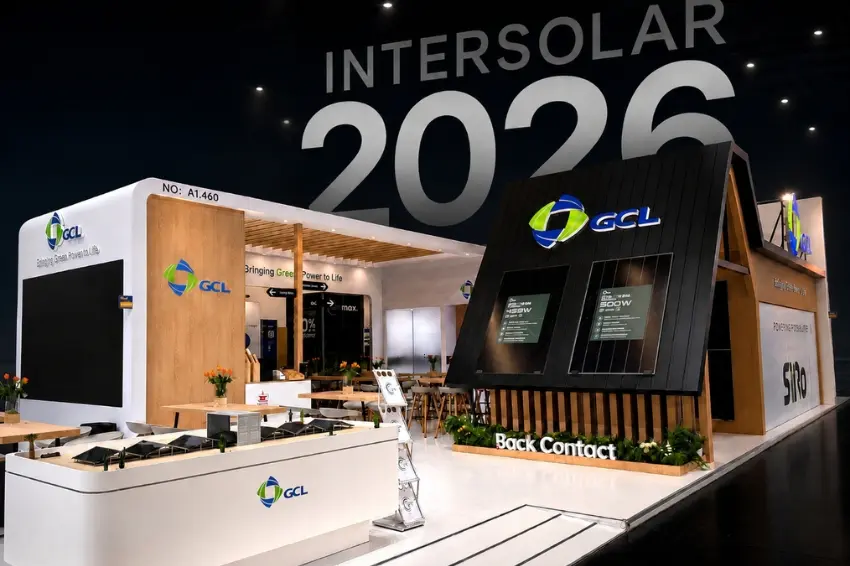
Back Contact (BC) cell technology will be one of GCL SI's key components for the next generation of high-efficiency photovoltaic modules.
The manufacturer will present the GPC 3.0 module to the Latin American market during Intersolar South America 2026, which takes place between August 25 and 27 at Expo Center Norte, in São Paulo (SP).
Unlike conventional architectures, BC technology concentrates the electrical contacts on the back of the photovoltaic cell, eliminating visible busbars on the front face.
The configuration expands the surface area available for capturing sunlight and, according to GCL SI, can provide an efficiency gain of approximately one percentage point compared to the technologies currently predominant in the market.
For the company, this architecture also opens a new path for advancing the efficiency of crystalline silicon cells.
“The BC architecture is the ultimate solution for crystalline silicon cells. We have already extensively explored TOPCon and HJT technologies, but both are approaching their physical limits. BC is opening a larger window for future efficiency improvements,” assessed Huang Gengwen, executive director of the Cell Research Division at GCL SI.
Initially presented at Intersolar Europe 2026, held in June in Germany, GPC 3.0 brings together a series of improvements aimed at increasing the efficiency, reliability, and performance of modules under real operating conditions.
Although originally developed for residential applications, BC technology is compatible with larger-scale projects and is now part of GCL SI's strategy for the utility-scale segment in Latin America.
Among the incorporated solutions are an optimized design to enhance irradiance capture, advanced passivation techniques to reduce electrical losses, multilayer dielectric films, new metallization solutions to decrease silver consumption, and the use of granular silicon produced by the FBR (Fluidized Bed Reactor) process.
One of the highlights is the so-called MAX design, which seeks to reduce interference on the front surface and expand the effective light-gathering area.
Combined with gradient multilayer dielectric films, the solution also aims to improve the antireflective behavior of the module under different irradiance conditions.
Another advancement relates to the passivation of the cells. According to GCL SI, the strategy adopted reduces losses caused by charge recombination on the surface and contributes to improved electrical performance.
In the manufacturer's production lines, GPC cells have already achieved an average conversion efficiency of 28,38%. However, this figure refers to photovoltaic cells and not the final efficiency of commercial modules.
Efficiency is at the heart of the technological dispute.
For GCL SI, efficiency should play an increasingly important role in the selection of photovoltaic modules in the coming years, including in centralized generation projects.
According to the manufacturer, removing the electrical contacts from the front surface of the cells allows for an increase in the area directly exposed to irradiance and, consequently, a higher power-to-area ratio for the equipment.
The company emphasizes that this advancement is different from the increase in power obtained simply by expanding the physical dimensions of the modules.
Over the past few years, some industries have adopted larger equipment as a strategy to increase rated power. This change, however, did not necessarily represent proportional gains in efficiency.
Furthermore, larger modules can impact other components of the project, requiring structures and trackers sized for new mechanical conditions and influencing the layout of the plants and the spacing between rows.
In recent years, the industry has moved towards greater harmonization of equipment dimensions. In this context, GCL SI believes that the ability to produce more energy using the same area should become one of the main factors of technological differentiation.
The manufacturer points out that, in the last decade, the efficiency of commercial modules has advanced from levels close to 15% to levels that today can reach approximately 25%.
In addition to Back Contact, the company points to technologies such as perovskite tandem cells as alternatives that could gain traction as they achieve scale and commercial viability.
Reduced use of silver and degradation.
Another distinguishing feature highlighted by GCL SI is related to the amount of silver used in the manufacturing of the cells.
According to the company, BC technology can consume about 20% less silver compared to TOPCon cells, reducing the exposure of production costs to commodity price fluctuations.
The company also points out differences in degradation over the lifespan. According to GCL SI, BC-based modules may exhibit annual degradation of approximately 0,35%, compared to about 0,40% for TOPCon technology.
One of the solutions incorporated into GPC 3.0 is precisely a new metallization strategy, combined with technologies such as 0BB (zero busbar), with the aim of reducing the amount of silver needed per watt produced.
Another component of the strategy is the use of FBR granular silicon produced by GCL itself. According to the manufacturer, the process contributes to greater material uniformity and a manufacturing process with a smaller carbon footprint, in addition to promoting consistent cell performance.
Impacts for utility-scale projects
In large-scale projects, the gains provided by efficiency are not limited to the individual performance of the module.
According to GCL SI, a higher power-to-area ratio allows a given installed power to be achieved using a smaller number of modules.
In practice, this can reduce components associated with the BOS (Balance of System) and related operating expenses, such as cleaning, maintenance, and equipment replacement.
The company also states that the technology can be incorporated without significant changes to the dimensions currently used by the industry, avoiding additional impacts on components such as trackers and cabling.
Less degradation also tends to increase the amount of energy produced over the lifespan of the project.
According to the manufacturer's assessment, the combination of higher efficiency, fewer modules, and reduced degradation can result in a comparatively lower LCOE (Levelized Cost of Energy) for projects based on BC technology.
Latin America enters the radar
The global photovoltaic module supply chain is currently undergoing yet another technological transition.
According to GCL SI, major manufacturers are gradually expanding their BC cell production capacity while simultaneously beginning to reduce the share of TOPCon-based lines.
The company compares the move to other transitions that have occurred in the photovoltaic industry, such as the shift from polycrystalline silicon to monocrystalline silicon and, later, from PERC cells to TOPCon.
In Europe, according to GCL SI, BC technology has already been adopted for at least two years in residential, commercial, and industrial applications.
In Latin America, the manufacturer states that it is already working on formalizing offers for BC modules in different countries for utility-scale projects scheduled for 2027.
The company expects the adoption of more efficient technologies to advance as production capacity increases and new generation projects are developed in the region.
In Brazil, however, the utility-scale market for BC technology is still nascent. GCL SI believes this scenario could change in the coming years, following the expansion of transmission infrastructure and the resumption of new centralized generation projects. Visitors to Intersolar South America 2026 will be able to learn more about GPC 3.0 at GCL SI's booth W5.30.
all the content of Canal Solar is protected by copyright law, and partial or total reproduction of this site in any medium is expressly prohibited. If you are interested in collaborating or reusing part of our material, please contact us by email: redacao@canalsolar.com.br.




Comments
Comments are moderated before publication.Comments should be respectful and contribute to a healthy debate. Offensive comments may be removed. The opinions expressed here are those of the authors and do not necessarily reflect the views of the author. Canal Solar.