

In this article, we will talk about the internal components of the solar inverter for connection to the electrical grid. This type of inverter, known as grid-tie, is used in distributed generation systems and centralized photovoltaic plants.
In either application, the components are similar, with only their dimensions and organization changing. A 1 MW inverter basically has the same components and control systems as its smaller 10 kW brother, for example.
Is the inverter all the same?
In a market where people are still not convinced of the importance of using connectors instead of using electrical tape, it is difficult to explain the importance of choosing the inverter carefully. On the outside, all inverters look more or less the same. But that is just the outside.
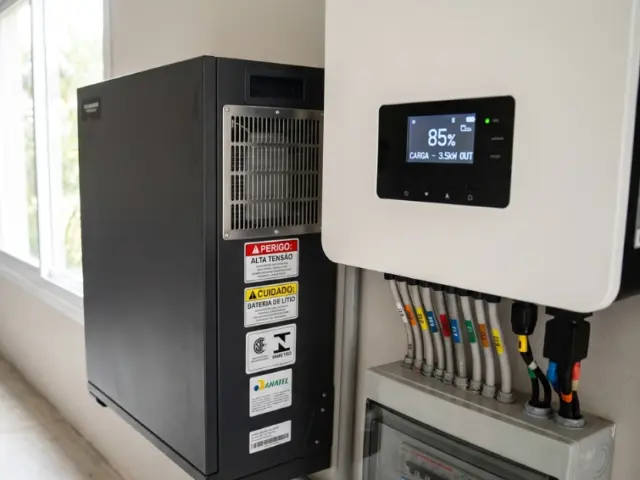
some have Design futuristic, while others are more old-fashioned. Some bring and keyboard for communicating with humans, while others have already abolished this obsolete interface (like the inverter in the photo below), which can be replaced by a mobile application.
After all, what is important to consider when choosing a solar inverter? Is there some kind of inner beauty in the inverter? Paraphrasing (and correcting) the late poet “May the ugly ones forgive me, but inner beauty is fundamental”.
Outside the inverter
There are dozens of brands of solar inverters currently available on the Brazilian market. I can remember a few: Fronius, SMA, Sungrow, Huawei, Omnik, SolarEdge, APS, Growatt, Solis, Refusol, Delta and… right now I can't remember any more.
Why are these brands remembered? Because they invest a lot in marketing and are well-known, or because they have some kind of differential? To avoid this article being labeled as biased, we will delve into technical aspects instead of focusing on brands, labels or opinions.
If it is possible to determine an initial filter for choosing inverters, in addition to the status of their brands, we can consider the following aspects: time of existence of the manufacturer, share of the global market, warranty period, presence of local technical assistance, tools and support channels, quality of after-sales service, price (important!) and… quality.

Quality is almost always the most difficult item to evaluate. All inverters sold in Brazil, up to the limit of 10 kW, must have INMETRO certification (National Institute of Metrology, Quality and Technology). Many believe that this certification is a certificate of quality, but it is not.
The certification only states that the equipment has passed a series of tests and meets certain requirements. Nothing can be said, with or without the INMETRO seal, about the quality of the inverter's internal components. Above 10 kW the situation is worse: the INMETRO seal is not necessary.
Manufacturers usually provide their international certificates, as required by energy providers. And we come back to the same point: these certificates say nothing about the quality of what is inside the box. Anyone who buys an inverter does not know what is inside.
Like most car buyers (like me), we don't really consider the engine hidden under the hood. We want to speed off without worrying. But that's not quite how it works.
Inside the inverter
The solar inverter is a complex electronic equipment, composed of a basic structure of power transistors, a control board with a microprocessor, input and output filters and auxiliary interface and communication systems.
In addition to these components, which constitute the hardware of the inverter, there are still sophisticated control and protection systems embedded in the microprocessor programming. It's a lot of technology. If you want to understand a little about how inverters work, I recommend reading this article Functions and technical requirements of photovoltaic inverters.
All this technology is so that you, the user, can live peacefully and not worry about whether the inverter is operating correctly or not. The photovoltaic system must be transparent to the user. We do not need to constantly remind them that it exists.
All we want is for the energy produced by solar panels (in direct current) to be efficiently and safely fed into the grid (in the form of alternating current). And at the end of the month we want to get rid of the energy bill. Do I need to open my inverter before buying it? How will this article be useful to me?
Look, no one needs to go around dismantling inverters. But one thing is true: these “famous” brands didn’t become famous by chance. The big ones players of the market, which have the largest sales shares, invest heavily in quality and technological development.
The big ones are not big by chance, at least “as far as” (borrowing the joke from a notorious colleague) to inverters.

Next, let's look at some components of an SMA brand inverter. In my opinion, SMA equipment, alongside Fronius, Sungrow, Solis and Solar Edge (brands that I consider top-notch) are the “Ferraris” of the solar market. I can speak more accurately about SMA and Fronius, as they are equipment that I have already used, tested and dismantled to look inside.
Capacitors, the big villains
Let's start by evaluating the electrolytic capacitors of the DC bus. These components are present in all solar inverters and also in any other equipment that has a direct current input.
The function of these capacitors is to keep the inverter's input voltage constant and also to filter ripples in the currents. Although necessary, capacitors are a problem for inverters. Along with power transistors, perhaps even before them, capacitors are the components most prone to defects and failures.
Typically, it is the capacitor that limits the lifespan of the device. It goes without saying that good capacitors are necessary to produce an inverter with long lifespan. Let's take a look at two devices of the same size, side by side.
From the outside we already know they are cute. Now, let's take a look inside. From a distance they look very similar, but inspection of the internal components reveals notable differences.

Looking more closely, we see the difference in quality of the electrolytic capacitors in the two devices. The generic inverter uses capacitors from a generic manufacturer. My first hypothesis is that the capacitors are connected in parallel.
Therefore, the nominal voltage of the capacitors (315V) is very close to the operational limit. This reduces the equipment's ability to withstand surges and overvoltages. My second hypothesis is that the capacitors can be connected in series, which reduces their capacitance by half, but doubles the working voltage.
This configuration would not be recommended (I hope this is not the true hypothesis) for two reasons: the series connection causes an unbalance in the voltage between the components, in addition to greatly increasing the internal resistance ESR. ESR is the acronym for “Equivalent Series Resistance".
In other words, it is an electrical resistance that every electrolytic capacitor has. This resistance, in addition to making it difficult for the component to perform its function, causes the component to heat up, leading it to the end of its life more quickly. Have you ever seen an old electronic board with those bulging capacitors?
The main cause of this is ESR. On the other hand, in the SMA equipment, we find a set of EPCOS electrolytic capacitors. Without wanting to advertise, it must be admitted that the best equipment in the world (solar inverters or anything else) is usually equipped with capacitors of this brand.
No need to say anything else, but let's continue. Let's see that the capacitors used in the SMA have a nominal voltage of 550V, higher than the maximum operating voltage. In the data sheet, the manufacturer specifies an operating voltage range and an absolute limit.
This limit is precisely the maximum voltage that the capacitor supports at its terminals, according to its specifications. We can see that the capacitors in the SMA equipment work loosely in relation to the voltage.
Furthermore, I can safely say that the capacitors are connected in parallel. Since there are six capacitors, the total ESR is reduced to 1/6 of the individual ESR of each component.

Power Transistors
Let's take our investigation a little deeper. We disassemble the inverters to take a closer look at their components. An important component of the inverter is the power electronic transistor.
Along with electrolytic capacitors, the transistor is one of the most critical components of the equipment. Power transistors function as on-off switches in a process called switching.
A solar inverter is a switched-mode electronic converter (like computer power supplies, for example). Typically, a transistor switches on and off about 30 times per second. Imagine that over several hours, days, and years of operation.
The transistor is subjected to a great deal of stress and will eventually fail, as its useful life is limited. The choice and sizing of transistors are essential in determining the durability of an electronic converter.
Below we show some information about the transistors used in the two pieces of equipment we are analyzing.


Comparative analysis: capacitors and transistors
The 3000W SMA inverter uses capacitors for 550V and transistors for 150A (at temperature of 25oC). The generic 5000W inverter uses 315V capacitors and 120A transistors. The first manufacturer is careful to oversize its components, delivering reliable and durable equipment to the market.
On the other hand, the generic inverter uses components with little clearance. Which of the devices do you think will fail first? The SMA inverter uses a larger transistor, which costs $1,11 more than the transistor in the generic inverter.
This makes a big difference in the final cost of the equipment (since five transistors are used), leading to an overpriced final product. It is true that this is not the price that the manufacturer will pay for the component.
We are simply doing a comparative cost analysis using the prices of a retail distributor as a reference. The important message is: the SMA manufacturer chose to use a more robust and more expensive transistor in its 3000W equipment, while the generic manufacturer uses a cheaper and inferior transistor for a 5000W equipment. Do you understand what we are talking about?
The SMA inverter used in this comparison has a nominal power of 3000W, while the generic one is 5000W. In other words, we are forcing this comparison in a very biased way. It is true: we are favoring the generic inverter.
As the saying goes, we're comparing bananas with oranges... and showing how oranges are superior. It's no secret in the electronics industry that transistors, in the best designs, must work with a good deal of slack.
This increases the component life and reduces the MTBF (Mean Time Between Failures), a well-known figure of merit in the industry. Loosely interpreted, MTBF is the time it takes for a given piece of equipment (on average) to fail.
Finally, looking again at the capacitors, observe the optimal working voltage of each inverter in the table, considering the nominal power and maximum input current specified by the manufacturer.
The operating voltage of the SMA inverter is far from the nominal voltage of the capacitors. Oversized capacitors are not a manufacturer's luxury. A (good) solar inverter is designed to have a service life of at least 15 years.
The generic inverter, on the other hand, has an operating voltage close to the maximum voltage of the capacitors and its life expectancy is much shorter.


DC disconnector switch
The disconnect switch is a minor component in the inverter. Its only function is to disconnect. That's it. How many times in the life of an inverter will someone activate the on/off switch, which connects the circuit of the photovoltaic modules to the inverter?
Almost never, you might be thinking – and rightly so. What few people know is that this switch, which is so rarely used, has to work very well when required. Two characteristics are important in the disconnector switch: current-carrying capacity during normal operation of the inverter and current-switching capacity.
The first characteristic (conduction capacity) ensures that the switch has small ohmic losses and does not reach high temperatures during normal operation.
The second (sectioning capacity) guarantees that the component will be able to interrupt the current without producing an electric arc, even with the inverter running, which could cause the component to melt and cause fire.

The disconnect switches used in most solar inverters employ rotary mechanisms. Disconnect switches are known to cause problems in DC circuits because their arc-interrupting capacity is very limited.
There is also a little-known fact on the market, which is discreetly mentioned in some equipment manuals: the rotary switch requires intentional activation a few times a year in order to clean the contacts.
Basically, you have to go to the inverter a few times throughout the year, during all the years of the equipment's life, to clean the switch contacts. By failing to do this, you are violating the manufacturer's recommendations and reducing the lifespan of the component (and consequently of the inverter).
The issue of rotary switches will always be a problem in most equipment. The next time you read an inverter manual, look for some guidance on the maintenance of the disconnector switch.
The inverter we take as a reference in this article uses a special type of non-rotating disconnector. This switch is manufactured by MERZ and is equipped with all SMA inverters.
This is a little-known detail that goes unnoticed by most consumers. You will only know this by looking inside the inverter. Non-rotary disconnect switches have a compression contact mechanism.
In addition to ensuring good electrical contact during equipment operation, disconnection (opening the circuit under load) is very fast. By turning the knob manually, the user releases a lock that instantly opens the contacts, safely extinguishing the electric arc.
Furthermore, according to the manufacturer, non-rotary switches do not require preventive maintenance. There is no need to do anything. A solar inverter equipped with this type of switch can operate for many years without us having to do anything to it.
An important comment, complementing what I said above: it is recommended, however, to inspect all electrical installations periodically, including the electrical connections of the photovoltaic modules to the inverters. In this case, I am referring to the installations and not to the inverter itself.
Inner beauty
Finally, the “beauty” aspect. This is a subjective and not very technical aspect. But there is something I always say: electrical installations and electronic boards must be beautiful and aesthetically pleasing.
Beauty, which is not what really matters, reveals the concern with the design and the care taken in the assembly. Looking more closely at the two pieces of equipment we see differences in Design that attract attention.
The generic equipment (with all due respect) has a certain homemade assembly feel, while the SMA looks like a work of art, giving the impression that its design was careful (and went through many years of development and maturation) and its assembly is mostly mechanized, except for the fittings of power and communication boards and cables.
I will be criticized by some readers for this subjective analysis regarding the inner beauty of inverters, but this difference is indeed noticeable. I invite the reader to someday open inverters from different brands and visually inspect every detail. Beauty is put on the table, yes, contrary to what the proverb says. Draw your own conclusions.

Conclusion
It's better to pay more for equipment that will last longer and won't let you down. This is a case where more expensive is better, without a doubt. You won't always be able to look inside a piece of equipment to know if it's better or worse than another.
So, research the manufacturers, their reputation, their customer service structure, their warranty period and other things I mentioned at the beginning of the article. The best criterion for choosing is the equipment's warranty period, which is usually directly related to the confidence the manufacturer has in its own equipment.
Secondly, in my opinion, it is very important that the manufacturer is willing to provide support and maintenance in case your equipment fails. Good luck with your choice. And when your inverter fails after two years of use, don't say I didn't warn you.



Comments (8)
Comments are moderated before publication.Comments should be respectful and contribute to a healthy debate. Offensive comments may be removed. The opinions expressed here are those of the authors and do not necessarily reflect the views of the author. Canal Solar.
Spectacular Article. Congratulations my dear Marcelo.
Congratulations Marcelo!
very transparent literature!
I worked with electronics from 1970 to 2.000 and always admired well-designed projects.
(with quality reservation)
This is what the planet needs.
Could anyone tell me which inverter topology is most used for single-phase systems?
Great text! Congratulations on the technical analysis of the components. However, just because the inverter is an SMA doesn't mean it won't have problems (I've had 2 SMAs that were replaced due to manufacturing defects in less than 2 years of operation). Cheap things can actually be expensive, but higher priced ones don't escape either.
Excellent explanation of the most important technical and support items for decision making.
Excellent article. I would like to know about Growaatt inverters, because I purchased one and when reading this text, I realized that it highlighted the company's time on the market and Growatt is only 10 years old. Do you have anything to say about this Growatt inverter?
In addition to SMA, I also work with Growatt, and despite being on the market for 10 years, they already have technical assistance and a call center for the best service. I have had experience with assistance and the shipping is at their expense, and the deadline for repair or exchange of the device is 30 days (to date, they have never failed to comply). A differentiator that I liked about the brand is that it can change parameters remotely and this saves a lot of travel and time spent going to the customer, being able to resolve the issue via the computer in my office.
The button inverter is already outdated, and the technical support leaves something to be desired.1