
Article published in the 14st edition of the Magazine Canal Solar
A IEC 60904-1:2020 standard (Photovoltaic devices – Part 1: Measurement of photovoltaic current-voltage characteristics) describes the general procedures for determining the IV curve and the electrical characteristics (voltage, current and power) of photovoltaic modules.
In addition to this first document, the publication IEC 60904-1-2: 2019 (Photovoltaic devices – Part 1-2: Measurement of current-voltage characteristics of bifacial photovoltaic devices”) deals with specific procedures for dealing with bifacial modules.
We need to know the definitions of terms that are used when we are dealing with bifacial modules, especially when we are working with IEC 60904-1-2.
It may seem trivial, but it is important to know the definitions of bifacial device, bifaciality and power gain due to back irradiance (known as BiFi) presented in the standard.
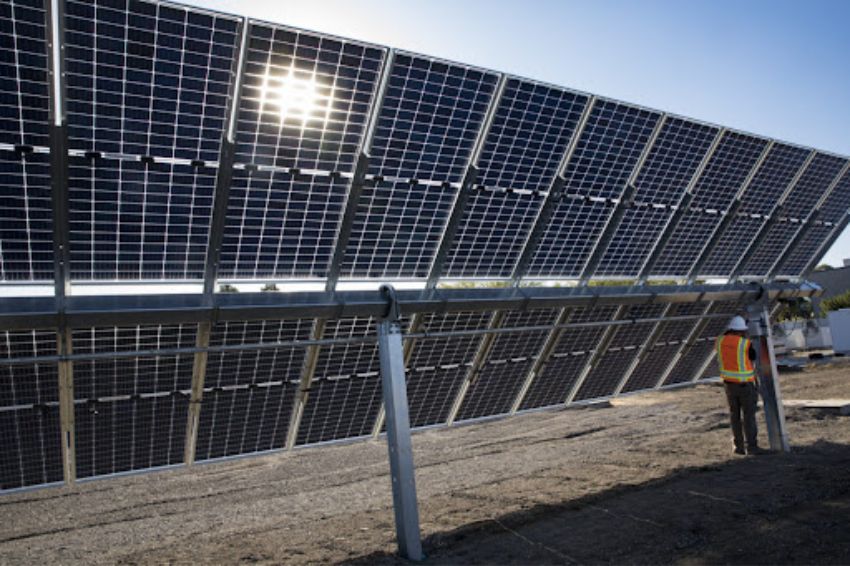
Um bifacial device is a photovoltaic device (cell or module) in which both sides are used to collect sunlight.
A bifaciality is a property that expresses the relationship between the main characteristics of the back and front of a bifacial photovoltaic device quantified by specific bifaciality coefficients, referenced in standard test conditions (STC – 1000 W/m², 25 °C, AM1,5, XNUMX).
The main definitions of bifaciality are: bifaciality of short circuit current; bifaciality of open circuit voltage; and bifaciality of maximum power.
The power gain due to rear irradiance (BiFi) indicates the increase in power, in addition to that obtained under STC conditions, per unit of rear irradiance, being expressed in W / Wm².
In general, the performance of bifacial photovoltaic devices in a solar plant depends not only on the irradiance that falls on the front surface, but also on the irradiance that falls on the rear surface of the device, which is affected by specific conditions at each location, such as albedo, size of the reflective surface, mounting structures, elevation of the devices and their tilt angle.
Due to the factors mentioned above, and in order to obtain measurement results that can be comparable, the measurement of the IV curve is carried out in such a way that it is possible to quantify the bifaciality of the device and the power gain due to the back irradiation that it can collect.
Thus, the bifaciality becomes an intrinsic property of the device, as opposed to site-specific conditions, such as albedo (a measure of reflectivity of a surface).
According to IEC 60904-1-2, the measurement conditions of bifacial devices must be proportional to their bifaciality. This can be guaranteed with the natural sunlight spectrum provided that it is in suitable conditions or in a solar simulator that can have its irradiance levels adjusted.
Even if all requirements are met, the measurement conditions will never be perfect, there is a deviation in the measurements – for this reason IEC 60904-1-2 establishes allowable deviations to obtain valid measurements.
In this article, the procedures for measuring the current and voltage characteristics of photovoltaic devices.
In this case, the experiment carried out here was carried out in a commercial bifacial module under simulated light, for comparison between data obtained in the laboratory and those shown by the manufacturer on the data sheet.
Want to know more? Download for free 14nd edition of the Magazine Canal Solar and read the full article.
The opinions and information expressed are the sole responsibility of the author and do not necessarily represent the official position of the author. Canal Solar.



Comments
Comments are moderated before publication.Comments should be respectful and contribute to a healthy debate. Offensive comments may be removed. The opinions expressed here are those of the authors and do not necessarily reflect the views of the author. Canal Solar.