
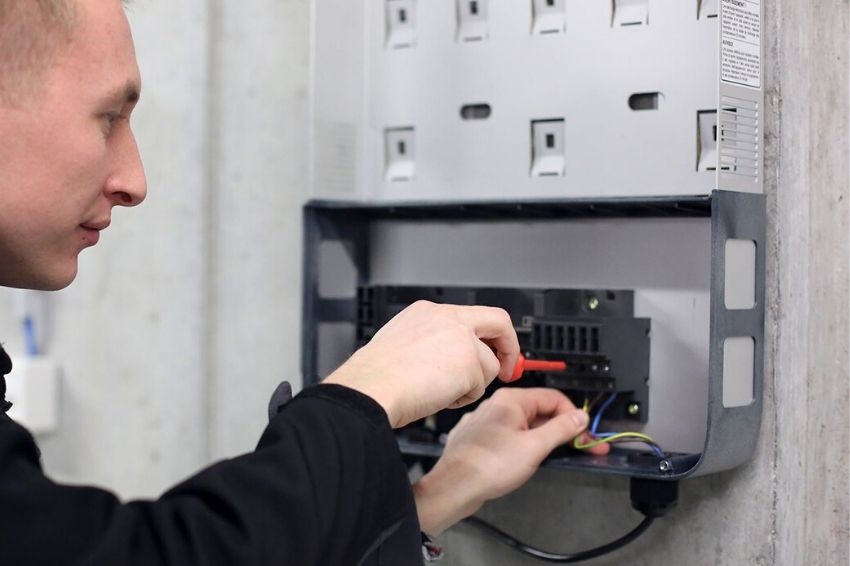
Photovoltaic inverters are subjected to a series of exhaustive tests and tests in the laboratory, in order to guarantee the best efficiency of these products when exposed to real situations. This is not exclusive to inverters.
Every industrialized product has specific tests and trials to guarantee its functioning under pre-established conditions according to its purpose.
For example, a car must have specific and strict tests regarding its stability, braking, frontal and side impacts, as well as other aspects of the vehicle, simulating real conditions, which may eventually occur.
These tests, in addition to guaranteeing greater protection, comfort and experience for users, also guarantee the useful life of the products that make up their assembly. Taking this analogy to the world of solar energy, inverters also undergo several tests to guarantee the basic principles of their operation.
After carrying out all tests and trials, manufacturers must submit their products for local certifications, carried out by competent bodies in each country or region, which, like the manufacturing company itself, understands that a given product must comply with some operating conditions and security so that it can be sold, and thus reach your home or business.
In addition to the tests provided for in standards, manufacturers committed to high quality standards carry out extra tests, with the aim of ensuring that under no circumstances will the products reach the levels of reliability required by the market. Some of these additional tests will be listed below.
Impact test
The test: The equipment is subjected to an impact of 10 Nm in pre-defined locations.
Objective: Ensure the resistance of the housing, especially when used in commercial environments and in installations with high ceilings.
Dust Test

The test: A fan is responsible for releasing a thin layer of talcum powder over the inverter.
Objective: Ensure that the equipment is impermeable to dust.
Low temperature performance test
The test: The inverter is exposed to extreme fluctuations in temperature and humidity.
Objective: Ensure the robustness and operation of the inverter in locations with extreme weather conditions.
Drop Test
The test: The equipment is subjected to a drop, from a pre-defined height in relation to the ground, onto a solid surface. Objective: Ensure, in addition to resistance, the stability of the equipment in the event of a fall.
Ultraviolet (UV) resistance test
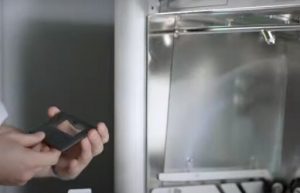 The test: The inverter is exposed to high-intensity sunlight (in the laboratory) for a long period of time.
Objective: Ensure the operation and useful life of the equipment in environments where it is not possible to shelter the inverters.
Electromagnetic Compatibility (EMC) Test
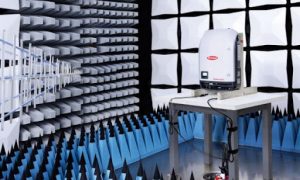
The test: Observe the effects of radiation and emissions at frequencies from 30 MHz to 1GHz.
Objective: Ensure compatibility with other electronic equipment, without any type of interference, either from other equipment in the inverter or from the inverter in other equipment.
Degree of protection test
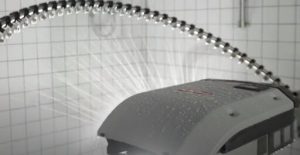
The test: A spray of water hits the Inverter in full operation.
Objective: Ensure the protection and sealing of the equipment against water ingress.
Durability test
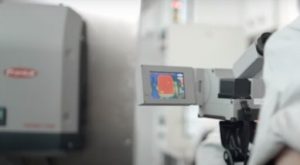
The test: The equipment is subjected to variations in ambient temperature from -20 °C to +100 °C.
Objective: Ensure the resilience of the device, especially for external installations, where the inverter is exposed to the most diverse climatic conditions.
Salinity Test
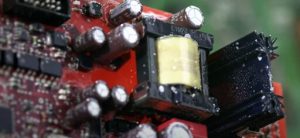
The test: A salt mixture is thrown towards the inverter for a long period of time (days).
Objective: Ensure resistance to corrosion, guaranteeing the best operation of the inverter in regions with high salt concentrations (coastal regions).
Conclusion
Tests as shown above aim to stress the inverters according to the conditions that can be found in the field, and attesting to the quality, durability and reliability of the products.
It is important to highlight that these tests go beyond what the standards require (e.g. ABNT NBR 16149 and certification INMETRO – Ordinance No. 004 of 2011), always guaranteeing the best performance, regardless of the region in which the equipment will operate.
This ensures the long useful life of the equipment, which can exceed 20 years of operation. It is worth remembering that the Fronius, as one of the pioneers in the solar energy market in Europe, has had inverters installed and operating since the mid-90s.
Therefore, attention to detail and the use of more demanding acceptance criteria (beyond the limits required by standard) attest that the equipment was well designed and is ready to withstand field conditions. Benefit for designers and owners, who gain greater reliability and the possibility of generating more energy in their photovoltaic plants.


Comments
Comments are moderated before publication.Comments should be respectful and contribute to a healthy debate. Offensive comments may be removed. The opinions expressed here are those of the authors and do not necessarily reflect the views of the author. Canal Solar.