
Brazil already has 4,7 million connected distributed generation systems, and 85% of integrators have already served a client who was left without support. What separates those who retain customers from those who abandon them happens in five predictable moments.
In the early 1980s, Jan Carlzon took over SAS and did the math: 10 million passengers, five contacts each, 15 seconds per contact. That was 50 million "moments of truth" per year, instants in which the company was judged.
With solar energy, the cost is lower but much more expensive: there are fewer instances, but each client decides whether that system becomes a referral, expansion, and maintenance contract, or just another orphaned customer.
01 – The installed base exploded. The conversion did not.
On September 11, 2026, the ABSOLAR (Brazilian Solar Energy Association) Brazil recorded 77,6 GW of installed solar capacity. (54 GW in distributed generation and 23,6 GW in power plants), exceeding by more than three months the 75,9 GW that the association itself projected for December.
Distributed generation alone accounts for 4.716.423 connected systems (July data). Each of these is a customer, and each customer goes through the same stages.
The problem is that selling has become more difficult in direct proportion to the growth of the customer base. Greener's study on the first half of 2026, presented on September 23 (434 valid responses, margin of error of approximately 5%), shows a market that has returned to budgeting, but is converting less and financing less.

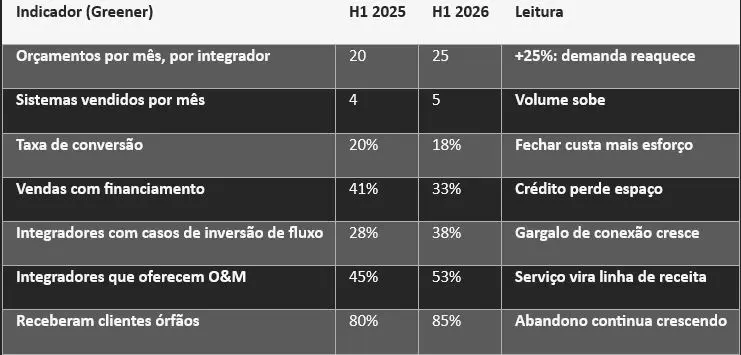
In other words: acquiring new customers became more expensive, while existing customers became more numerous and more sought after. The arithmetic of growth shifted.
02 – Why “moments” and not “satisfaction”
Satisfaction is an average. Loyalty is decided at specific touchpoints, and customer experience research is consistent on this: according to PwC, 32% of customers leave a brand they love after a single bad experience.
Qualtrics (2025) estimates that 11% of consumer experiences are bad and that, after such experiences, 47% of customers reduce their spending, while less than a third complain. Bain showed in 2005 that 80% of companies believed they delivered a superior experience, and only 8% of customers agreed.
A solar customer doesn't evaluate your company just once. They judge it five times, and you're not even in the room for four of those evaluations.
For the integrator, the most useful data comes from Bain: promoters account for more than 80% of referrals, and detractors for more than 80% of negative word-of-mouth. In a sector where referrals are the main sales channel (89% of integrators cite them as one of the top two, according to Greener), the five stages below represent your inverted sales funnel.
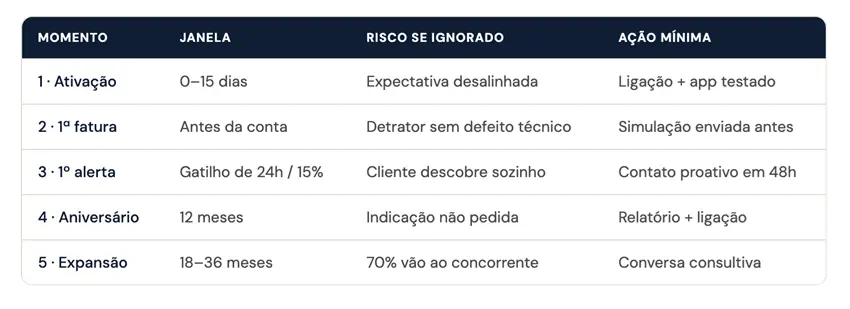
03 – The five moments
Phase 1 · Activation day up to 15 days
The turning point
It's the customer's emotional peak and the only time they hear everything. It's also where the complaints that now flood complaint portals originate: delivery below expectations and a monitoring app that the customer never managed to access. Almost none of them start as a technical defect. They start as expectations that no one calibrated.
What to do: Deliver the installed and tested app, inform the expected monthly generation (including the winter drop), and provide a contact person with a name. Call between the 7th and 15th day. Metric: % of customers with an active app within 15 days.
Moment 2 · Before and after the first invoice
The account that didn't reach zero.
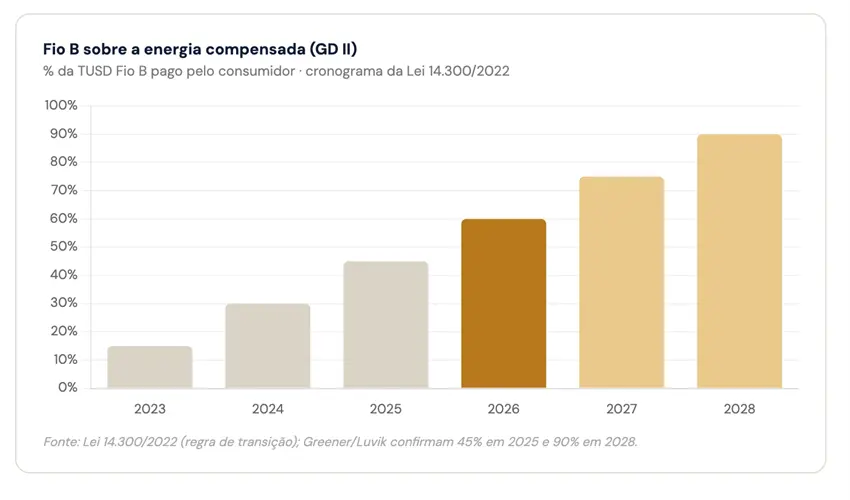
Here is the moment that generates the most detractors without any fault whatsoever. According to Law 14.300, systems connected after January 2023 pay an increasing share of the TUSD Fio B (Transmission System Usage Tariff) on the compensated energy: 60% in 2026, reaching 90% in 2028. Added to this is the availability cost (30, 50 or 100 kWh, depending on the connection).
The customer who hears "almost zero bill" and receives a three-digit bill feels cheated, even though the system is working perfectly.
 What to do: Simulate the first bill and send it to the customer five days before it arrives, explaining credits, availability, and Fio B. The average payback period for a residential GD II system was 3,2 years in the first half of 2025 (Greener): show this along with the data. Metric: % of customers notified before the first bill.
Moment 3 · First system alert
When the inverter disconnects
It will always happen: offline inverter, disconnected string, dirty module. What the customer remembers is not the fault itself, but who noticed it first. Since less than a third of dissatisfied customers complain, the integrator who waits for the phone to ring discovers the problem too late, or never.
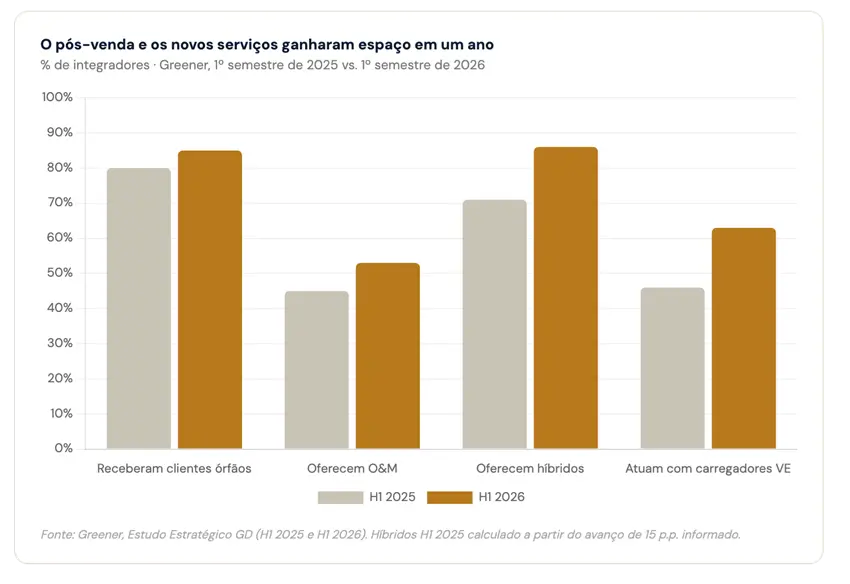
The good news is that the market is already organizing itself for this: 53% of integrators offer O&M, and the activity is shifting from maintenance to optimization, with 44% citing performance improvement studies and 35% citing retrofitting.
What to do: Define a trigger (system offline for more than 24 hours or a drop above 15% without a weather-related cause) and contact the customer before they notice, providing a diagnosis or solution within 48 hours. Metric: % of alerts handled before customer contact.
Moment 4 · 12-month anniversary
The report that becomes a recommendation.
One year is the point at which the customer has already seen the real savings and still remembers who installed the service. It's the window of greatest likelihood of a referral, and almost no one uses it. Without a report on savings generated, accumulated energy generation, and CO₂ avoided, the conversation lacks momentum; with it, asking for a referral ceases to be a favor and becomes a consequence.
What to do: Send the annual report, call to discuss it, and ask a single question: "Who in your family or at work would benefit as much as you would?". Metric: Referrals per 100 clients on their birthday.
Stage 5 · 18 to 36 months
The expansion conversation
According to Solfácil (June 2025), 70% of expansions go to a professional different from the original installer. In 2026, the triggers multiplied: the electrified fleet reached 837,000 vehicles in the first half of the year (+34% since December 2025), 63% of integrators already work with chargers, and 86% offer hybrid systems, although only 38% have sold a battery; price is the main barrier (36%).
There is also a regulatory factor. On November 9th, ANEEL presented the proposal for the Time-of-Use Tariff (Joint Technical Note 14/2026), which provides for time-of-use tariffs and reaches consumers with their own generation, with phased implementation starting in April 2028.
The proposal still depends on board approval, but it's already a topic of conversation: experts point out that it changes the economic equation for batteries. Your client will ask someone. Let it be you.
What to do: start the conversation with the customer's economic history and current consumption profile (electric car, new air conditioning, larger family), and only then talk about the product. Metric: % of the customer base contacted with an expansion proposal within 36 months.
Conclusion
With 4,7 million connected systems and 85% of integrators receiving clients that someone else left behind, after-sales service has ceased to be a differentiator and has become contested territory. Five moments, five simple actions, none requiring expensive software. They require someone responsible for them. Whoever doesn't take care of their own customer base will discover, through a client calling another, that it already has an owner.
Sources
- ABSOLAR / Canal Solar, 09/11/2026: 77,6 GW (54 GW GD, 23,6 GW GC) and projection of 75,9 GW. ABSOLAR, data panel: 4.716.423 distributed generation systems (20/07/2026).
- Greener, Strategic Study GD H1 2026, presented on 09/23/2026 (434 valid responses, margin of error ~5%), via Canal Solar. Comparisons H1 2025: Greener H1 2025 (1.188 responses).
- PwC, Future of Customer Experience (2018). Qualtrics XM Institute (2025). Bain & Company, Closing the Delivery Gap (2005).
- Greener, Strategic Study GD 2025 (2024 data): indication cited by 89% of integrators; GD II payback of 3,2 years (H1 2025).
- Solfácil, study with 187 companies (June 2025): 70% of expansions were carried out by another professional.
- ANEELJoint Technical Note 14/2026 (On-Time Tariff), 09/11/2026: proposal subject to board approval. Law 14.300/2022. Jan Carlzon, Moments of Truth.
The opinions and information expressed are the sole responsibility of the author and do not necessarily represent the official position of the author. Canal Solar.

Comments
Comments are moderated before publication.Comments should be respectful and contribute to a healthy debate. Offensive comments may be removed. The opinions expressed here are those of the authors and do not necessarily reflect the views of the author. Canal Solar.