
There is a strong trend towards the expansion of the use of bifacial modules in photovoltaic projects. This family of modules is expected to become standard in the construction of solar power plants in the coming years. The main advantage of the bifacial module is that it allows light to be captured from the rear, something that is not possible with conventional modules. Rear capture is especially interesting in ground-based plants, where it is possible to use the light reflected by the surface.
Read also
One of the main questions in the market is how to predict the performance of bifacial modules in solar plant projects. In their data sheets, some manufacturers generally show, in addition to the STC characteristics (standard test condition), the expanded electrical characteristics of bifacial modules, indicating their behavior when they receive (typically) an additional 30% of solar irradiation — which causes directly increases output power and short-circuit and maximum power currents.
The performance of a bifacial solar module in operation is conditioned by several factors and its determination depends on measurements made in the field or simulations carried out using modeling tools. Modeling bifacial systems is complex and includes factors such as albedo, distance from the ground, type of soil, the existence of nearby objects, the use of fixed systems or with trackers and the characteristics of photovoltaic cells and modules.
The albedo (or reflection coefficient) is the ratio between the light reflected by the surface and the light incident on it. It is measured on a scale that goes from zero, for no reflection from a perfectly black surface, to 100%, for perfect reflection, from a completely white surface.
Case study with software modeling
As previously stated, a frequent question in the market is how to calculate or predict the performance of bifacial photovoltaic systems in the design phase. Computer programs for simulating photovoltaic systems can be used to predict and estimate the performance of solar plants with bifacial modules.
A 53,88 MWp solar plant was modeled by the AE Solar engineering team in PVSyst software with the following characteristics:
- 97.950 AE 545 W (53,38 MWp) mono and bifacial panels;
- Simulation with and without monoaxial tracker;
- Ground height: 1 m;
- Bifaciality: 70%;
- Albedo: 20%;
- Without tracker: 30° tilt angle.
The software modeling aimed to understand the gain in bifaciality, that is, the energy gain of the plant with bifacial modules in relation to what would be obtained with the same plant if it were built with conventional modules.
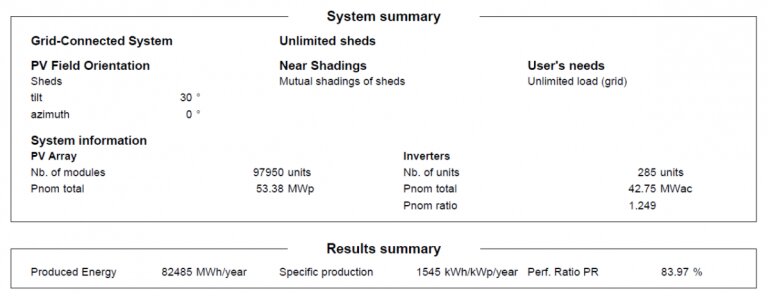
The results shown in tables I and II, obtained with PVSyst, show the values of energy produced with conventional and bifacial modules — 82.485 MWh/year and 86.318 MWh/year, respectively. The plant with bifacial modules presents an additional generation of 4,65%.
Table 1: Simulation results on PVSyst – fixed system and conventional modules
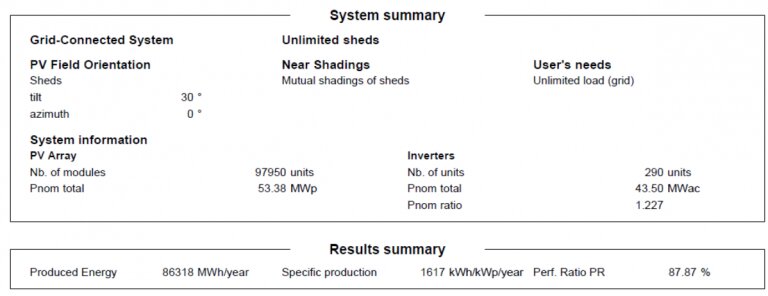
Table 2: Simulation results on PVSyst – fixed system with bifacial modules
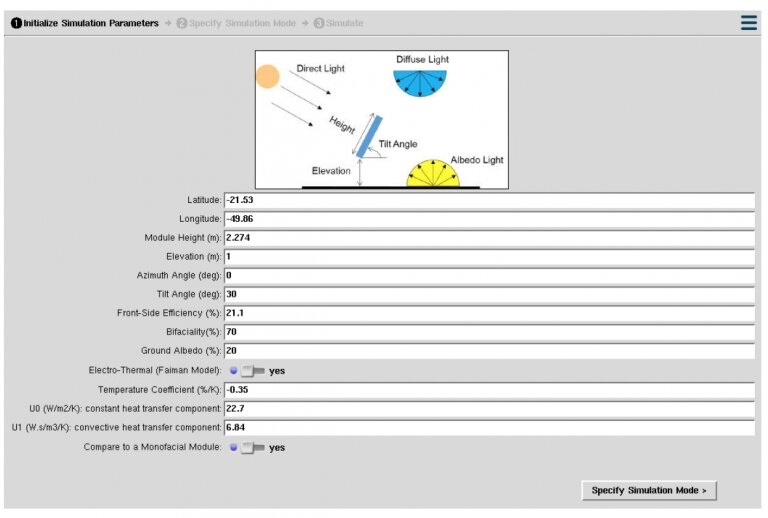
For comparison purposes, the solar plant was also modeled using the Bifacial PUB simulator (Purdue University, Indiana) [2].
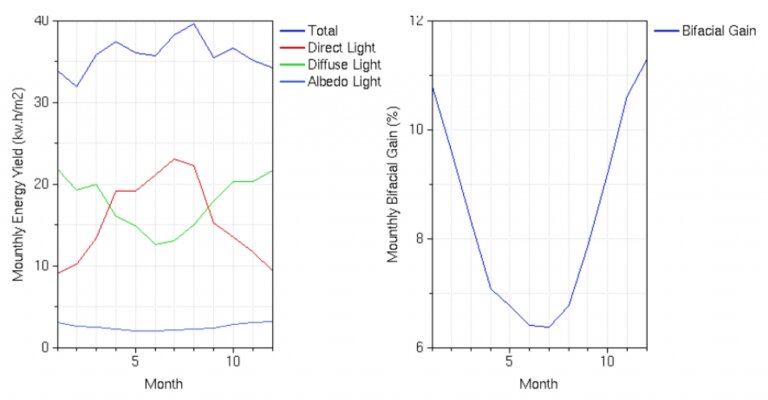
Under the same conditions as the previous simulation, Bifacial PUB provided a superior result. In the figure below, the graph on the right shows the monthly bifaciality gain, which results in an average annual gain of 8,42% with bifacial modules
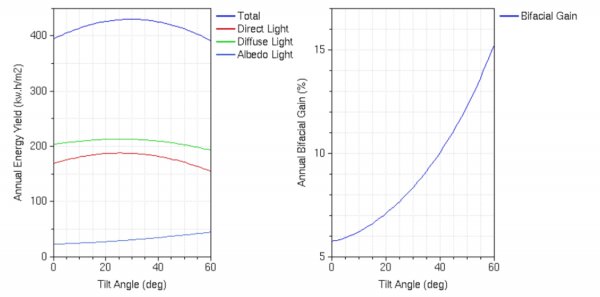
An important result obtained with Bifacial PUB is that the bifaciality gain increases with the inclination angle of the solar panels, as shown in the graph on the right, in the following figure.
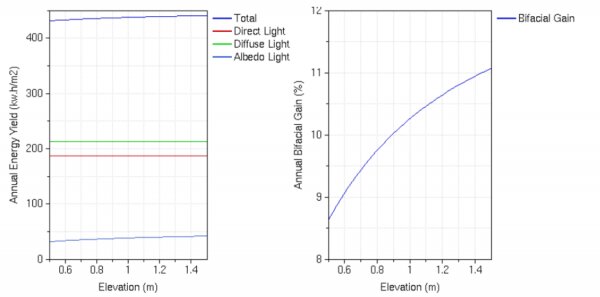
Bifacial PUB also shows that the bifaciality gain increases with the height of the solar modules in relation to the ground. Although it is already an expected result, the software allows you to quantify the gain for each specific project, considering the input variables provided by the user.
Finally, it was possible to verify in Bifacial PUB the relationship between the bifaciality gain and the albedo (soil reflection index). In this case, there is a practically linear relationship, as illustrated in the graph on the right in the following figure.
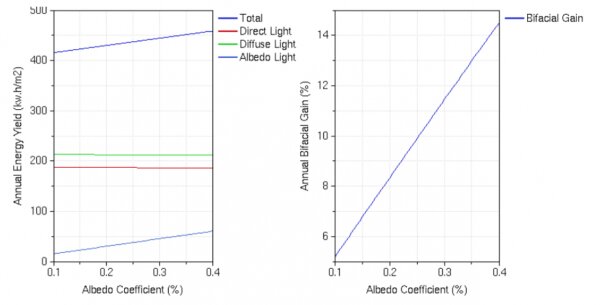
An important comment is that albedo, which has a direct influence on the result, is a variable surrounded by uncertainty in projects. In this case the albedo was estimated at 20%, according to references [1], [5] and [6]. The best option, however, would be to measure the albedo in the location where the solar plant is intended to be installed.
The energy generation and bifaciality gain obtained in Bifacial PUB are summarized in the table below.
Table 3: Results obtained in Bifacial PUB. Source: AESolar/Reproduction
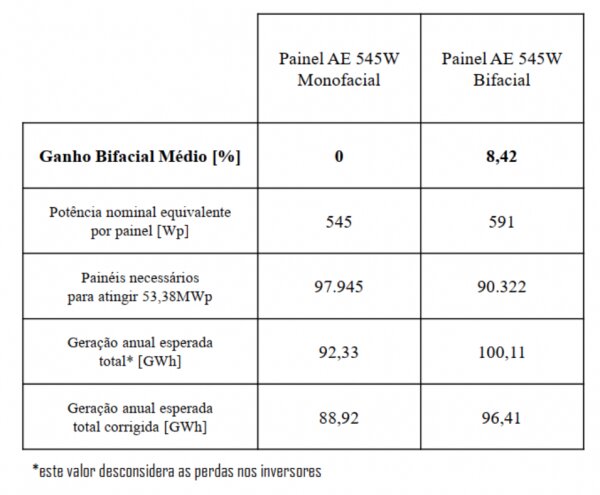
The results presented in tables I, II and III show that there is a certain discrepancy in the results obtained with the different tools. The complexity and uncertainty of computational simulations increase when bifacial modules are added to projects. There are still doubts about the sophistication of the simulators known on the market (such as PVSyst) for this type of problem.
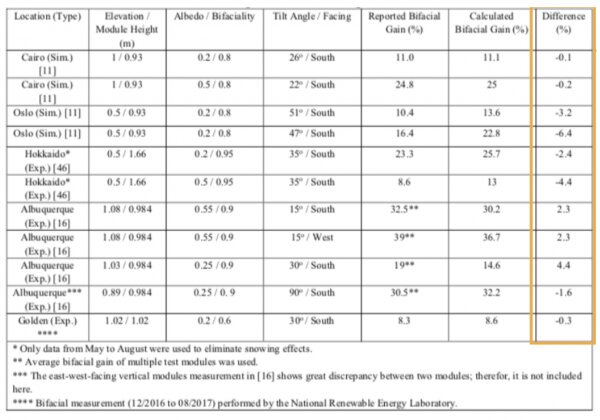
Comparing the results of Bifacial PUB and PVSyst shows that the gain obtained with the first is almost double that reported by the second, which may cast doubt on the accuracy of the results we can obtain with these tools. The table below, taken from reference [3], shows simulation results compared with real results from solar plants located in different regions of the world.
In all cases, the Bifacial PUB simulator presented very close results, with very small errors. The Bifacial PUB simulator provides interesting and apparently reliable results, with the only drawback being the impossibility of simulating systems with tracking.
Table 4: Validation of Bifacial PUB simulations with real results from solar plants in different regions of the world. Source: [3]
A fact not considered in this modeling is that solar plants rarely employ fixed systems. Many solar plants employ trackers, which typically provide a generation gain of close to 15%. The combination of trackers and bifacial modules has the potential to further increase the generation gain of photovoltaic plants.
Conclusion
This article presented a case study of a bifacial solar plant modeled in two software programs: PVSyst and Bifacial PUB (from Purdue University). The study was based on a project carried out with bifacial modules from AE Solar in Brazil. The validation of simulation tools, including PVSyst and the Purdue University tool, also requires studies in Brazilian climate conditions, especially with the use of experimental data obtained over a long period.
more articles
You can learn more about bifacial modules in these articles Canal solar:
-
Bifacial modules with PVSyst: factors to consider
-
Bifacial modules dominate the photovoltaic sector in 2020 in Brazil
-
Bifacial modules are available for DG projects in Brazil
-
Performance of bifacial modules using optimizers in a PV system
-
Compatibility between bifacial photovoltaic modules and optimizers
-
Factories must produce only bifacial cells in the future
References
- [1] Reise, C. 2014. “Predicting Yields for Bifacial PV Systems” Freiburg, Germany: Fraunhofer Institute for Solar Energy Systems ISE
- [2] Zhao, B., Sun, X., Khan, M.R., Alam, M.A. 2018. “Purdue University Bifacial Module Calculator (PUB)” West Lafayette, Indiana: Network of
- Photovoltaic Technology, Purdue University
- [3] Sun, X., Khan, M.R., Deline, C., Alam, M.A. 2017. “Optimization and Performance of Bifacial Solar Modules: A Global Perspective” West
- Lafayette, Indiana: Network of Photovoltaic Technology, Purdue University
- [4] Pelaez, S. A., C. Deline, P. Greenberg, J. Stein, and R. K. Kostuk. 2018. “Model and Validation of Single-Axis Tracking with Bifacial
- Photovoltaics: Preprint.” Golden, CO: National Renewable Energy Laboratory. NREL/CP-5K00-72039
- [5] Dobos, E. 2003. “Albedo”. Milskolc, Hungary: University of Milkolc
- [6] Gul, M., Kotak, Y., Muneer, T., Ivanova, S. 2018. “Enhancement of Albedo for Solar Energy Gain with Particular Emphasis on Overcast Skies” Published on MDPI Energies



Comments
Comments are moderated before publication.Comments should be respectful and contribute to a healthy debate. Offensive comments may be removed. The opinions expressed here are those of the authors and do not necessarily reflect the views of the author. Canal Solar.